



Commercial waste should be collected often enough that bins remain usable throughout normal operations without recurring overflow, hygiene problems or reactive collections. There is no single daily, weekly or fortnightly schedule that is right for every business.
The appropriate commercial waste collection frequency depends on more than total weekly waste volume. It also depends on when waste is generated, how consistently bins fill, the type of material being stored and how operations change over time.
The useful question is therefore not simply how many collections a business needs each week. It is how long the current bin can reliably support normal operations before reaching a practical service limit.
Setting Commercial Waste Collection Frequency Around Actual Site Demand
The right servicing frequency becomes clearer when a business looks at how waste builds up between collections, what sets the practical service limit and whether those patterns remain consistent over time. These factors help show whether the current schedule is working or needs to be adjusted.
Start With the Service Limit, Not a Standard Schedule
A collection interval should reflect how long a bin can function properly between services.
That limit is not always the point when the bin becomes completely full.
For one site, available bin space may be the constraint. At another, waste may need to be removed earlier because of odour, hygiene or pest concerns. Warehouses and production sites may also experience sharp increases after deliveries, shifts or production activity even when the weekly average looks manageable.
Business Queensland’s tips for improving business waste practices includes checking bin sizes, estimated fullness and collection frequency to understand existing waste volumes. This provides a more reliable basis for adjusting collection schedules rather than assuming similar businesses need the same service intervals.
A suitable schedule should generally:
- provide enough capacity for normal waste volumes;
- allow for ordinary variation between collection cycles;
- prevent recurring overflow or unsuitable storage conditions; and
- avoid bins being collected with substantial unused space week after week.
The aim is not to make every bin exactly full when it is collected. Waste generation is rarely that predictable.
The better goal is a repeatable service cycle that works under normal operating conditions.
How Do You Know if Commercial Waste Is Being Collected at the Right Frequency?
The most useful evidence comes from patterns across several normal collection cycles.
One overflowing bin may result from an unusual event. One half-full bin may simply reflect a quiet week. Neither is enough to judge the whole schedule.
Instead, look at when the pattern occurs and whether it keeps happening.
| What you are seeing | What it may mean | What to do next |
| The bin is consistently close to full shortly before collection but rarely overflows | The current frequency is probably close to normal demand | Keep the schedule unless the pattern begins to change |
| The correct waste repeatedly fills the bin well before collection day | The interval may be too long, or the bin may not provide enough capacity | Check whether the bin fills at roughly the same point each cycle, then compare a shorter collection interval with a capacity change. |
| The bin fills mainly after the same trading days, deliveries, shifts or production activity | Waste generation is concentrated around predictable periods | Consider moving a collection closer to the peak before adding more services |
| The bin is routinely collected with substantial unused space | The site may be serviced more often than normal demand requires | Check several representative weeks before reducing frequency |
| One waste stream fills quickly while another remains lightly used | The problem may be how waste is being separated rather than the collection interval | Review bin placement, signage and staff understanding before changing the schedule |
| Overflow mainly occurs after missed or failed collections | The normal frequency may already be adequate | Address why the scheduled collection is not occurring reliably |
This approach helps prevent a business from changing its schedule in response to every isolated full bin.
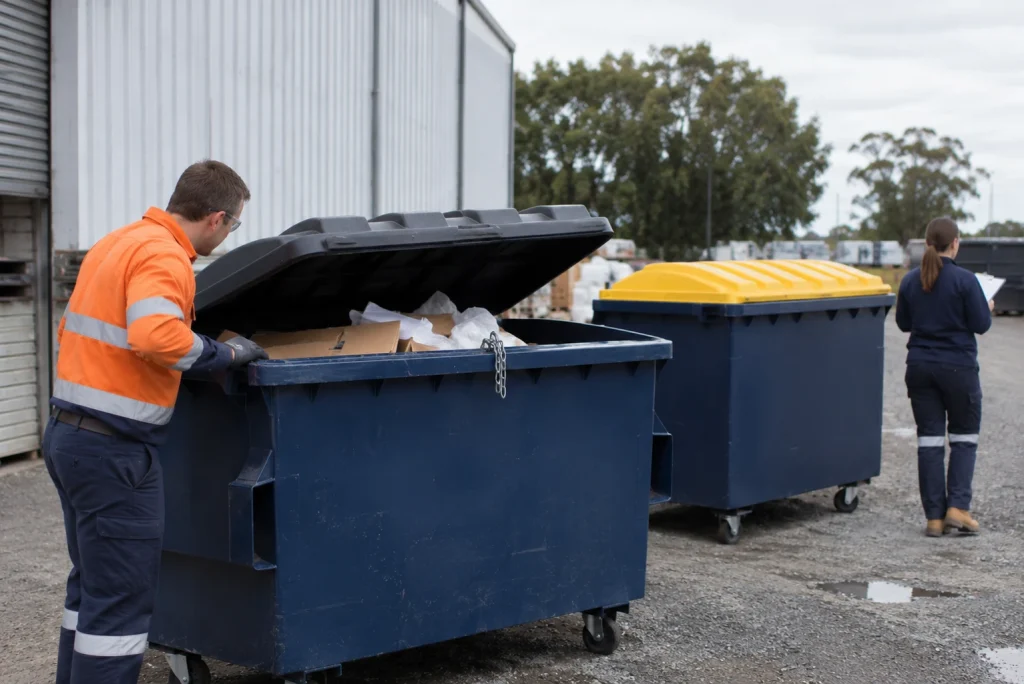
It can also reveal situations where more collections would not solve the actual problem. For example, additional general waste services will not correct poor separation if recoverable materials are taking up much of the available bin space.
Where it is unclear whether storage or servicing is the real constraint, choosing between bin size and collection frequency starts with understanding how waste accumulates and whether more storage or more frequent collections would better suit the site.
Collection Timing Can Matter as Much as Frequency
Two businesses can both receive two collections per week and still have very different results. The spacing of those services matters.
A hospitality business may generate most of its waste after several busy trading days. A warehouse may use much of its packaging capacity immediately after major deliveries. Manufacturing and other industrial sites can experience similar peaks around particular shifts, production runs or maintenance periods.
In these situations, the site may not need another collection. It may need the existing collections to occur at better points in the operating cycle.
For example, a bin collected shortly before a predictable waste peak may have plenty of unused space when emptied, then overflow before the next service.
Moving that collection closer to the high-generation period could provide the required capacity without increasing the total number of weekly services, where the servicing arrangement allows it.
This creates an important distinction:
Collection frequency tells you how often the bin is emptied. Collection timing determines whether those services occur when the site actually needs the capacity.
Both should be reviewed when a schedule is no longer working.
Different Waste Streams May Need Different Service Intervals
There is no reason to assume every waste stream at a business should automatically be collected on the same schedule.
The appropriate interval depends on both how quickly the material accumulates and how it can be stored.
Dry cardboard may occupy substantial space after deliveries without the same odour or putrefaction constraints as food-related waste. In contrast, food organics waste collection may need to occur before the bin is physically full, particularly when odour, hygiene or storage conditions become the limiting factor.
These differences highlight why food waste collection schedules need to consider more than bin capacity. Food Standards Australia New Zealand’s food premises waste storage and hygiene requirements explain that storage facilities must accommodate the amount and type of waste produced until removal. The guidance also notes that refrigerated garbage storage may be necessary for some businesses to prevent putrefaction and odour, reinforcing why collection intervals should reflect the characteristics of the waste being stored.
This means a food-related waste stream can reach its practical service limit before its physical capacity is exhausted.

Heavy or unusually dense materials create another issue. A container may reach practical handling or servicing limits without being completely full. In that situation, shortening the collection interval may not be the best response. Another container or collection method may be more appropriate.
The collection schedule should therefore reflect the characteristics of the waste, not simply the capacity printed on the bin.
Set the Regular Schedule Around Normal Demand
A commercial waste collection schedule should generally reflect normal operating conditions rather than the busiest week of the year.
Otherwise, temporary peaks can lead to permanent over-servicing.
It helps to separate normal demand from predictable temporary peaks.
Normal demand is the waste generated through ordinary trading, staffing, deliveries or production. The regular collection schedule should handle this reliably.
Temporary peaks can result from:
- seasonal trading periods;
- periodic stock movements;
- short production campaigns;
- shutdown or maintenance work;
- events or projects; and
- other temporary operational increases.
If the normal schedule works for most of the year, temporarily adjusting services during a known peak may be more practical than maintaining the higher frequency permanently.
The reverse is also true.
What was once a temporary peak can become normal activity. A warehouse may permanently increase stock throughput. A hospitality venue may add trading days. A manufacturing site may introduce another production shift.
If additional collections are repeatedly required under ordinary operating conditions, the base schedule may no longer reflect normal demand.
Can Commercial Bin Collection Frequency Be Changed?
Yes. Collection frequency should be reviewed when the conditions behind the original schedule change.
The important question is whether the change affects how quickly the relevant waste stream reaches its practical service limit.
Common triggers include:
- additional or reduced trading and operating days;
- permanent changes in production volume;
- new shift or delivery patterns;
- introducing a separate recycling or organics stream;
- changing bin capacity;
- changing the waste storage area or collection window;
- sustained increases in occupancy or activity; and
- sustained reductions that leave bins consistently underused.
Better waste separation can have a particularly important effect.
Suppose cardboard previously occupied a large proportion of a general waste bin. Once that material is separated, the general waste bin may take much longer to fill.
Keeping the old general waste collection schedule could then mean paying for a service frequency based on a waste mix that no longer exists.
At the same time, the newly separated cardboard stream will need its own suitable collection schedule.
This is why collection frequency should be reviewed after significant changes to waste separation rather than assuming the existing timetable will remain appropriate.
When Is Collection Frequency Not the Real Problem?
The interval between services should only be changed when it is actually contributing to the problem.
If recyclable material is taking up general waste capacity, better separation may solve the issue without adding another collection. If overflow follows failed services, the priority should be addressing missed commercial waste collection causes rather than shortening an otherwise suitable collection interval.
Bin capacity can create a similar false signal. A container that predictably fills under normal conditions may need a different capacity rather than additional vehicle visits.
Heavy, bulky or irregular waste introduces another possibility. The material may be unsuitable for the existing container or collection method, meaning a different waste stream or container is more appropriate than more frequent servicing.
Where several factors are occurring at once, a site-specific business waste assessment can help identify what is driving the problem and whether the existing service arrangement still matches normal operating conditions.
Collection frequency should be considered as part of optimising a waste management program for businesses, rather than adjusted independently of bin size, waste separation and other site requirements.
Setting a Commercial Waste Collection Schedule That Keeps Working
So, how often should commercial waste bins be collected?
The right interval is one that keeps the relevant waste stream manageable throughout a normal collection cycle without recurring overflow, unsuitable storage conditions or unnecessary servicing.
A business can make that decision more reliably by looking at when bins approach their practical limit and whether the same pattern repeats across several collection cycles. It should also consider whether waste generation peaks on particular days or whether the waste mix and operating conditions have changed.
The number of weekly collections is only part of the decision. Timing, waste characteristics and changes in normal operations can be just as important.
Premier Waste can help businesses review business waste services against current collection needs, including whether existing service intervals still reflect current waste volumes and operating patterns.
If your current servicing pattern no longer matches when and how waste is generated, request a review of your waste collections with Premier Waste to determine whether the timing or frequency needs to change. The contact URL is proposed and must be confirmed.





You must be logged in to post a comment.