

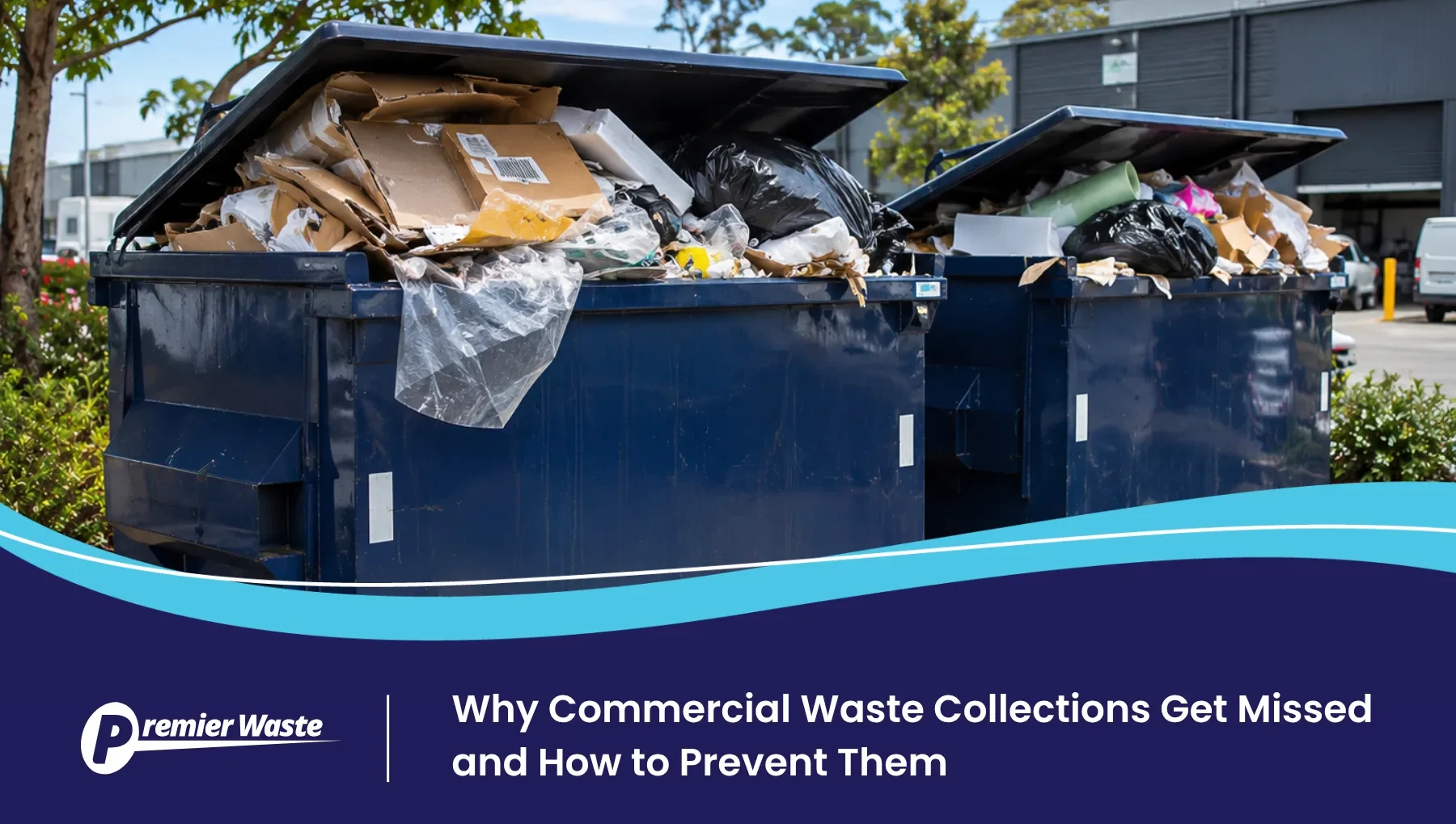

Commercial waste collections can be missed when the scheduled service cannot be completed safely or the bin is not ready to be collected. Common site-related causes include blocked access, unavailable gates, overfilled or excessively heavy bins, unsuitable materials and changes to normal site conditions.
However, a bin being left unemptied does not automatically mean the same thing happened every time. A service may have been unable to proceed because of conditions onsite, or the scheduled collection itself may have been delayed or not completed.
The useful first step is therefore to establish why the collection was missed before changing the waste setup. A one-off obstruction needs a different response from a recurring access problem, and an overloaded bin needs a different response from a service-frequency problem.
What Are the Most Common Commercial Waste Collection Problems?
Most recurring commercial waste collection problems fall into a small number of categories: vehicle access, site or bin readiness, overfill or weight, contamination and changes to normal operating conditions.
A waste company may be unable to empty a commercial bin where servicing it would be unsafe, where the bin cannot be reached or presented as expected, or where its contents are unsuitable for the agreed collection.
The important distinction is between the immediate reason the collection could not proceed and the underlying condition that allowed the problem to happen.
What Should You Do If a Commercial Waste Collection Is Missed?
Before arranging a change to the service, establish what happened as close to the scheduled collection time as possible.
A practical first response is to:
- Confirm the collection status. Check whether the service was attempted, delayed or recorded as unable to proceed and obtain the reason where one is available.
- Inspect the bin and collection area. Look at access, bin position, fullness, visible contamination, gates and anything surrounding the collection point.
- Consider what conditions existed at service time. A driveway that is clear at midday may have been blocked by deliveries or parked vehicles earlier in the morning.
- Correct the immediate problem where possible. This might mean clearing access, presenting the bin correctly or addressing an unsuitable material before another collection is arranged.
- Record the cause if the problem has happened before. Repeated incidents are more useful when considered as a pattern rather than as unrelated missed services.
Where service notes, photographs, site CCTV or other service-verification information are available, these can help establish whether the conditions seen later in the day were the same conditions present when the collection was attempted.
The aim is not to assign blame. It is to avoid changing bin capacity, collection frequency or site procedures based on the wrong diagnosis.
Check the Whole Vehicle Access Path, Not Just the Bin Area
A bin can appear accessible while the route required to service it is not.
For commercial waste collection, access extends beyond the space immediately around the container. Consider the complete path from the site entrance to the collection point and back out again.
Problems can include:
- vehicles parked across the access route;
- deliveries occupying loading areas;
- gates or roller doors being closed;
- insufficient room to approach or manoeuvre;
- stored pallets, stock or equipment narrowing the route;
- pedestrian or forklift activity around the collection area;
- height restrictions or overhead obstacles; and
- access being available only at certain times.
This distinction becomes especially important at shopping centres, warehouses, factories and logistics sites where the same loading area may be used by waste vehicles, delivery trucks, forklifts and other site traffic at different times.
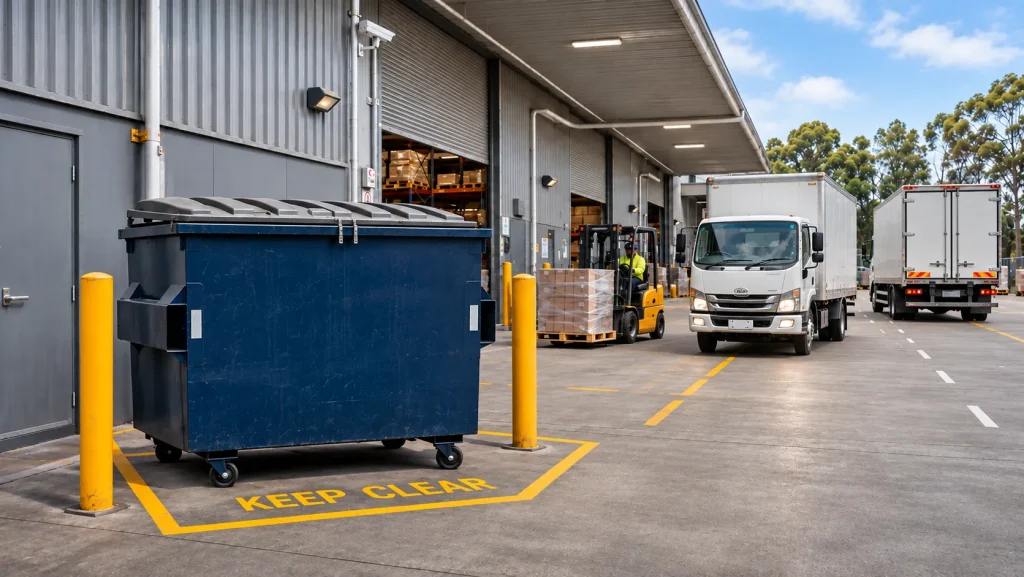
Safe collection depends on the conditions along the entire vehicle access route, not just the space around the bin. These risks are also recognised in the National Heavy Vehicle Regulator’s Waste and Recycling Industry Code of Practice registered in 2024.
The code provides guidance on managing safety risks associated with waste transport, including areas shared by pedestrians and heavy vehicles. It also recommends assessing site access, vehicle movements and operating conditions, and reviewing arrangements when those conditions change. This reinforces why recurring collection access problems should be addressed through suitable site and servicing arrangements.
These access issues can also create safety risks for workers involved in waste collection. WorkSafe Victoria highlighted these concerns in its waste transport safety inspection program, which focused on loading and unloading, vehicle maintenance and load restraint. The initiative reinforces the importance of identifying and managing safety risks during waste collection, particularly where vehicles operate in confined or busy areas.
A recurring access problem should therefore be treated as more than “someone blocked the bin again”. The underlying issue may be that the agreed collection point or service window regularly conflicts with normal site activity.
Check Whether the Bin and Site Were Ready at the Service Time
Readiness problems are slightly different from permanent access problems.
The collection area may be suitable, but successful servicing may depend on something happening before the vehicle arrives.
For example, the site may require:
- a gate to be unlocked;
- a security team to provide access;
- a bin to be moved from storage to an agreed collection point;
- vehicles to be moved from a loading area;
- a roller door to be opened; or
- another onsite activity to finish before the waste area becomes accessible.
A retail or hospitality site may have problems when early collections occur before the person with access arrives. At a warehouse or manufacturing facility, a collection may instead clash with shift changes, dispatch activity or incoming deliveries.
If this happens repeatedly, the solution may not be reminding one employee more often. An internal waste management plan for businesses can document collection points, access requirements, service windows and staff responsibilities, reducing the risk of the same problem occurring again.
An Overfilled Bin and an Overweight Bin Are Not the Same Problem
A bin does not have to look completely full for its contents to create a servicing problem.
Waste volume and waste weight are different constraints. A container holding bulky packaging may reach its physical capacity while remaining relatively light, whereas a partially filled container containing unusually dense material may become too heavy for the normal collection arrangement.
This means a bin that is repeatedly unable to be serviced should not automatically be replaced with a larger one.
Other presentation problems can include material protruding from the container, waste accumulating around the bin, or damage that affects how the container can be safely handled.
For safe collection, businesses should ensure their commercial and industrial waste collection arrangements account for vehicle access, bin weight limits, contamination and safe bin handling.
Where overflow is recurring, first establish what is creating it. If normal waste volumes genuinely exceed available capacity, evaluating bin site against collection frequency can help identify the more suitable adjustment. However, when bins only fill before particular services, determining how often commercial waste needs collecting may reveal whether collection timing or frequency needs to change.
But if the bin is only partly full and has become unusually heavy, the more useful question may be whether the material itself still suits that container or waste stream.
That distinction can be particularly important where manufacturing, workshop or other industrial activity introduces denser or different materials into an existing waste setup.
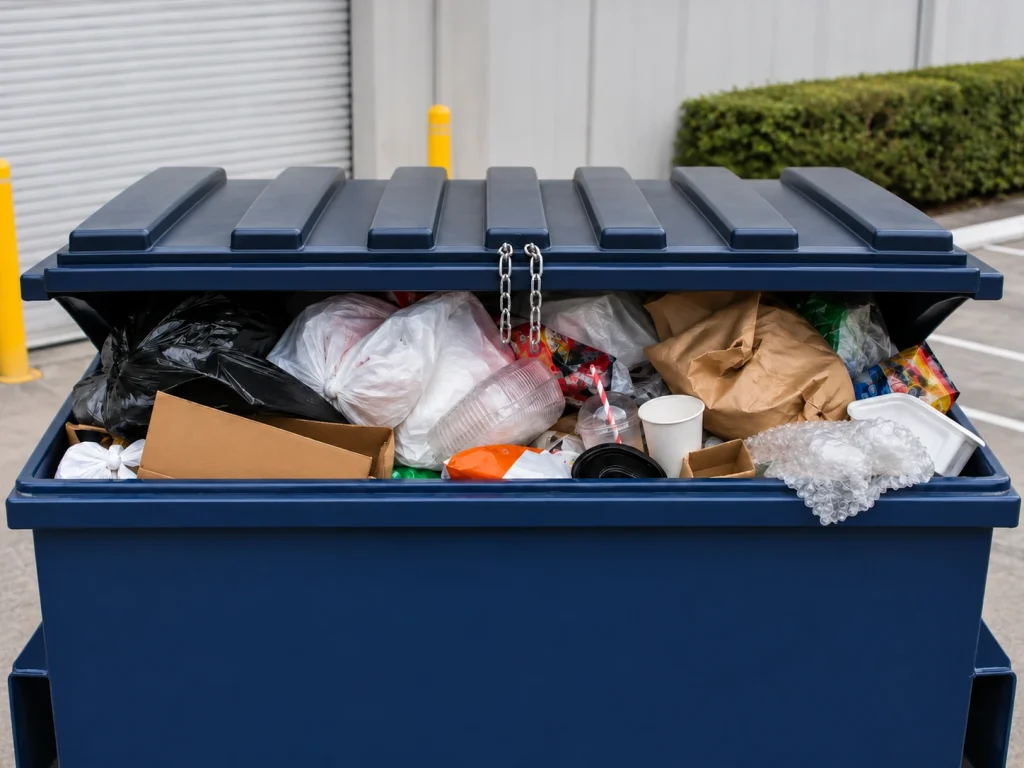
Contamination Can Make the Collection Problem a Waste-Stream Problem
Contamination should also be diagnosed rather than treated as a generic reason for a missed collection.
Not every incorrect item will necessarily prevent a bin from being serviced. The significance depends on what has entered the bin, the intended waste stream and the requirements of that service.
For example, if the same incorrect material repeatedly appears in a recycling stream, the underlying problem may be where the material is being generated, whether the appropriate waste stream is available nearby, or whether staff understand where it belongs.
If a specialist or higher-risk material appears in a standard commercial waste bin, the issue may instead be that the material requires a different storage or collection pathway.
Booking another collection without understanding the material does not resolve that problem. The first question should be what is in the bin and whether it belongs in that stream.
Diagnose Recurring Missed Collections by Their Pattern
One missed collection provides limited information. Several similar incidents can reveal where the setup is failing.
| What keeps happening? | What it may indicate | What should the business check? | Likely next review |
| Collection is missed at the same time or day | Normal site activity conflicts with servicing | Deliveries, parking, loading activity, pedestrian movements, gates and service timing | Collection point, service window or site procedure |
| Bin repeatedly overflows before collection | Available capacity does not match demand between services | When the bin fills, what material uses the capacity and whether the pattern is predictable | Bin capacity, frequency or waste separation |
| Bin is not full but becomes too heavy | Waste characteristics have changed | Whether denser or different material has entered the stream | Container type or waste stream |
| Contamination repeatedly comes from the same area | Source-separation problem | Where the incorrect material originates and whether the correct stream is practical to use | Bin placement, signage, staff guidance or stream availability |
| Gate or bin is repeatedly not ready | Collection depends on an unreliable hand-off | Who normally provides access or moves the bin and what happens when that person is unavailable | Access procedure or service window |
| Missed services occur without a recurring onsite condition | Cause may not be the site configuration | Service records and the recorded outcome of each collection | Investigate the service event before redesigning the setup |
The purpose of the table is not to diagnose every incident from one symptom. It is to identify what information should be checked next.
Where several different problems are occurring at once, arranging a site waste assessment for your business can help establish whether capacity, waste separation, collection timing or another part of the site’s arrangements is contributing to repeated missed collections.
Prevent Missed Collections by Removing Recurring Failure Points
Preventing commercial waste collection problems does not necessarily mean adding more service.
Often the better approach is to remove the condition that repeatedly makes the existing service unreliable.
For example, a business can review whether:
- the collection route remains clear during the actual service window;
- the bin can be serviced without relying on a single employee being present;
- gates and security arrangements match collection timing;
- the waste area provides enough space for normal operations and collection;
- changes in production, deliveries or trading have altered the site’s waste pattern;
- unsuitable materials are repeatedly entering the same stream; and
- previous missed collections show the same cause.
If successful servicing requires staff to move cars every week, temporarily stop warehouse activity or repeatedly clear materials from around the bin at the last minute, the problem may be built into the arrangement itself.
Keeping collection areas clear is also addressed in local government guidance. The City of Sydney’s guide on business and waste services explain that businesses should store bins within their premises and ensure bins presented for collection do not obstruct traffic, parking or pedestrian access. Although these requirements apply within the council’s area, they illustrate how bin placement and collection readiness can affect safe servicing.
Collection reliability also depends on how the waste area is designed and used during normal operations. The NSW EPA’s local council waste and recycling resources include better-practice guidelines for commercial and industrial facilities, covering equipment choices, waste storage, site layout and collection access. These guidelines highlight why recurring access problems may require changes to the waste area or servicing arrangements rather than repeated short-term fixes.
Treat Recurring Missed Collections as Feedback on the Waste Setup
A recurring missed collection is useful operational feedback.
It can indicate that the waste arrangement no longer reflects the way the site operates today. A new tenant may have changed parking conditions. A warehouse may have altered its delivery schedule. Production may have increased. A gate-access procedure may no longer match staffing hours.
The right response depends on the cause. It might involve a different collection point, clearer access arrangements, another service window, a capacity or frequency review, better waste separation or changes to onsite procedures.
Where recurring collection problems reflect wider changes in site operations, they should be considered as part of improving business waste management programs, rather than treated as a series of isolated failed collections.
Premier Waste’s commercial and industrial service process includes reviewing waste profiles, production patterns, servicing times, bin placement, truck access and contamination risks. Its fleet also uses GPS tracking, onboard cameras and digital service verification, which can support visibility around collection activity.
This allows industrial and commercial waste collection arrangements to reflect actual site conditions, including waste volumes, service times, bin placement and vehicle access. Where several waste streams or collection methods need to be considered together, Premier’s business waste and recycling solutions provide options for a coordinated service arrangement.
If recurring collection problems suggest your existing setup no longer suits the site, contact Premier Waste to review your current waste arrangement and request a quote.




You must be logged in to post a comment.