


Business waste removal costs are best reduced by removing inefficiency from the service arrangement, not by cutting bins or collections until the site struggles.
Across commercial premises and industrial operations, the safest savings usually come from identifying capacity that is consistently unused, correcting waste-stream problems, improving when services occur and reducing the need for reactive collections.
The important distinction is between reducing the service and optimising the service. A lower waste invoice is not a genuine saving if the change creates overflow, urgent collections, additional staff handling or disruption around storage, loading or production areas.
What Actually Affects Business Waste Collection Costs?
There is no single commercial waste collection price that applies to every business.
The cost depends on the service the site actually requires, including what waste is generated, how much there is, how it is stored, how often it must be removed and what happens to it after collection.
The same principle applies across industrial operations, where production patterns, material weight, larger waste volumes or different collection systems may further influence the setup.
| Cost factor | Why it can affect cost | What to check |
| Waste type and disposal pathway | Different materials may require different recycling, treatment or disposal processes | Is the material in the most appropriate waste stream? |
| Waste volume and weight | Greater amounts or heavier material can change storage, collection and disposal requirements | Is the amount normal, temporary or partly caused by poor separation? |
| Bin configuration | The number, type and capacity of containers affect how much can be stored between services | Is the available capacity actually being used? |
| Collection frequency and timing | More services mean more collections, while poor timing can leave a site short of capacity at the wrong point | Could existing services be spaced more effectively? |
| Site access | Collection windows, truck access and site constraints can influence how easily the service can be completed | Are avoidable access issues affecting servicing? |
| Contamination or unsuitable material | Incorrect material may affect how a waste stream can be handled or processed | Is contamination recurring, and why? |
| Reactive services | Overflow and unexpected waste increases can lead to additional pickups or handling | Are extra services genuinely unusual, or becoming routine? |
A retail or hospitality site might see waste rise with trading activity. A warehouse may experience peaks after major deliveries, while a manufacturing facility may generate more waste during particular production runs.
The business environment matters because it changes when, where and how waste is generated, rather than because each industry follows one standard price.
How Are Waste Collection Costs Calculated?
Commercial waste collection costs are generally calculated from the combination of services required for the site rather than a universal per-bin formula. The factors above are considered together to determine the appropriate container or collection system, servicing requirements, transport and disposal pathway.
For an office, this might result in a relatively straightforward combination of general waste and recycling services. A factory or workshop may require a different configuration because of heavier materials, greater volumes or operational access requirements.
The important point is that the price follows the service requirement. Reducing the price of one component does not necessarily reduce the total cost of managing waste at the site.
What Does a Waste Bin Actually Cost a Business?
A commercial waste bin cost can refer to two different things:
- the cost of the physical container itself; or
- the ongoing cost of having the waste in that container collected and managed.
For most businesses, the ongoing service arrangement is the more useful comparison.
A smaller or cheaper bin may cost more overall if it has to be emptied more frequently. A larger container can create the opposite problem if substantial capacity is paid for but repeatedly left unused.
The same principle applies to larger operational sites. A warehouse or manufacturing facility may need greater capacity or a different collection method, but the most economical option is still the one that suits the material and servicing pattern rather than simply providing the largest container available.
If the real question is how much capacity the site needs, assessing commercial waste bin size against waste volumes should come before comparing bin prices.

Why Can Waste Disposal Be Expensive?
Waste collection is only one part of what a business may ultimately be paying for.
Once material leaves the site, it may need to be transported and directed to an appropriate recycling, recovery, treatment or disposal facility. Costs can therefore be affected by:
- the type and weight of the material;
- transport distance;
- the processing or disposal pathway required;
- facility charges; and
- applicable regulatory or landfill levies.
For industrial operations, these factors can become particularly important where materials are heavy or bulky, or require a different handling or treatment pathway. Commercial premises can face the same underlying issue when substantial volumes of avoidable material are being sent through general waste.
Landfill levies are one example of why location and disposal pathway matter.
In Victoria, the industrial and municipal landfill levy rates published by the EPA show that industrial waste attracts a levy of $177.19 per tonne at metropolitan landfill premises for 2026–2027, compared with $155.95 per tonne at rural premises. For municipal waste, the levy is also $177.19 per tonne at metropolitan premises but drops to $88.42 per tonne at rural premises.
Meanwhile, Queensland’s waste levy rates include commercial and industrial waste, with rates varying by levy zone and waste category.
These are landfill levy rates, not commercial waste collection prices. They do not include bins, collection, transport or other processing and facility charges.
Their importance is that they show why a generic “cost per bin” figure can leave out a significant part of the overall waste-management cost.
Find the Cost Problem Before Cutting the Service
Reducing business waste removal costs safely starts with identifying where the current arrangement is actually inefficient.
One half-empty bin does not prove that a service should be removed. Likewise, one overflowing bin does not prove that another collection should be permanently added.
Instead, look for recurring patterns such as:
- substantial unused capacity before collection week after week;
- one waste stream filling much faster than others;
- recoverable material occupying a large share of general waste capacity;
- recurring urgent or additional collections;
- services occurring at the wrong point in a predictable trading, delivery or production cycle; or
- short-term increases in waste becoming part of the permanent service arrangement.
Checking bins shortly before collection and recording their size, estimated fullness and collection frequency can help reveal whether unused capacity or overflow is recurring. Looking at the pattern across several normal collection cycles provides a better basis for changing the service than reacting to one unusually busy or quiet period.
For a commercial site, that might reveal spare capacity outside peak trading periods. At an industrial site, comparing waste levels across delivery schedules, shifts or production cycles may reveal why the same bin is underused at some points and overloaded at others.
Where several factors are interacting, assessing your business waste requirements can help determine whether unnecessary costs come from capacity, servicing, the waste mix or another operational condition.
Reduce Unused Capacity Without Removing Useful Headroom
Some unused space is necessary.
Waste generation rarely stays exactly the same from one collection cycle to the next, so a service needs enough spare capacity to absorb ordinary variation without immediately creating overflow.
The stronger optimisation opportunity is consistent, substantial unused capacity.
If a bin repeatedly reaches collection day well below its practical capacity during representative operating periods, check whether that unused capacity comes from:
- the bin being larger than necessary;
- having more bins than the site normally uses; or
- collections occurring more frequently than normal demand requires.
That applies whether the waste comes from day-to-day commercial activity or production, warehousing and other industrial operations.
The objective is not to make every bin completely full. It is to remove capacity the business repeatedly pays for but does not need while preserving enough operating buffer for normal variation.
Where it is unclear which variable should change, comparing bin size and collection services can help identify the more suitable adjustment.
Check the Waste Stream Before Cutting General Waste
Sometimes the apparent cost problem is not how much service the business has. It is what is using the available capacity.
Effective general waste management starts with making sure general waste capacity is being used for the materials that actually need that stream, rather than being unnecessarily occupied by recoverable materials that could be separated.
An office or retail site may have recyclable cardboard occupying substantial general waste space. A warehouse can experience the same problem after deliveries, while recoverable packaging or production materials can also affect how quickly general waste capacity is consumed at an industrial site.
Simply reducing general waste in these situations can create overflow without correcting the cause.
Increasing general waste capacity can be equally inefficient because it provides more room for the same material mix.
Separating an appropriate recoverable material may reduce how quickly general waste capacity is used. Once that pattern becomes established, the business can reassess whether its previous general waste capacity and collection schedule are still required.
However, adding another waste stream is not automatically a saving. The additional stream has its own container and collection requirements.
The better comparison is the cost and performance of the whole revised arrangement, not the price of one waste stream in isolation.
Improve Collection Timing Before Paying for More Service
Frequency is not the only reason bins overflow.
A business may already have enough weekly collections but receive them at points that do not match when waste is generated.
For example:
- a hospitality venue may generate most waste after its busiest trading days;
- a warehouse may experience a packaging peak following major deliveries; and
- a manufacturing site may produce predictable increases after particular shifts or production runs.
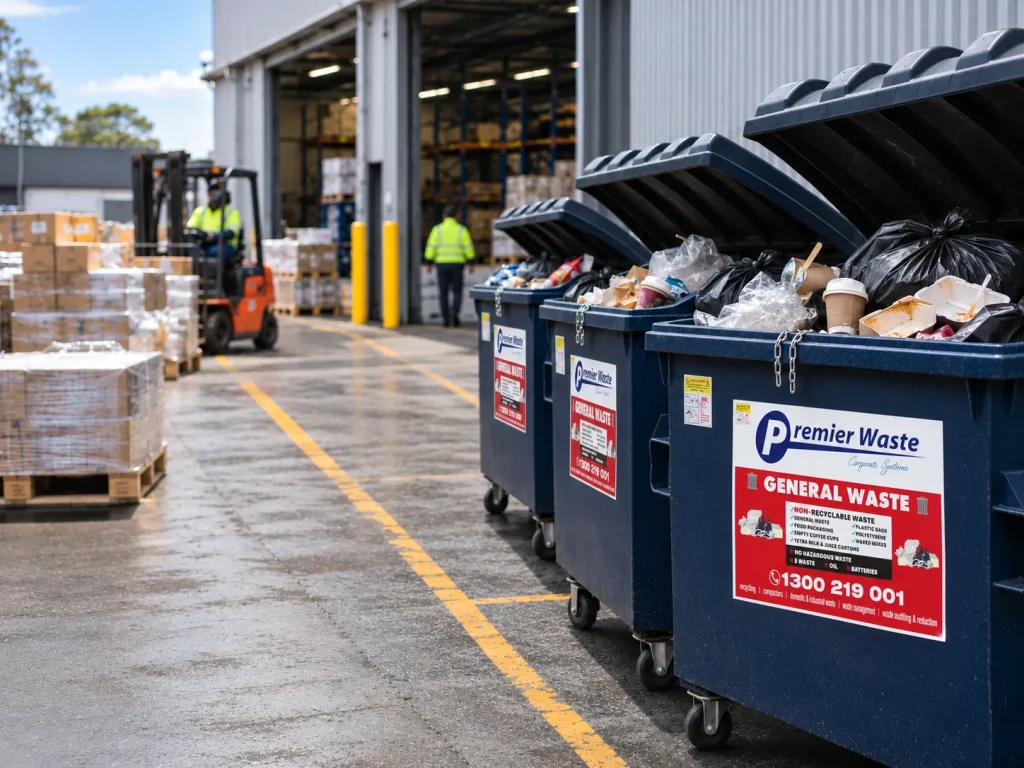
If a collection occurs immediately before the quieter part of that cycle, the bin may have unused capacity when it is emptied but run out of space later.
Where the servicing arrangement allows it, moving the collection closer to the waste-generation peak can make the same number of services more useful.
If the interval itself is consistently unsuitable rather than simply poorly timed, choosing an appropriate waste collection frequency requires a closer look at how quickly the site fills its available capacity.
Keep Temporary Waste Peaks Out of Permanent Costs
Not every increase in waste should become part of the regular service. Seasonal trading, unusual stock movements, maintenance work or temporary production activity can all create short-term peaks.
If the normal arrangement works for most of the year, temporarily increasing capacity or collections during a known peak may cost less than maintaining that higher service level permanently.
The reverse also matters. If additional collections are repeatedly needed during ordinary operations, the increase may have become normal demand and the base service should be reviewed.
Make Sure a Lower Waste Bill Does Not Create a Higher Operating Cost
A genuine saving should reduce the total burden on the business, not just one line on the waste invoice.
After changing a service, watch for signs that the cost has simply shifted elsewhere:
- overflow or waste accumulating outside the intended storage area;
- increased urgent or ad hoc collections;
- staff spending more time moving or consolidating waste;
- loading areas, storage zones or workspaces becoming obstructed;
- contamination increasing because different materials are competing for limited capacity; or
- odour, hygiene or pest problems becoming more frequent.
In a commercial setting, those problems can affect staff, customers and storage areas. In warehouses, factories and workshops, they can also interfere with vehicle movement, production space or material handling.
A saving that repeatedly creates additional labour or operational disruption is not necessarily an optimisation.
The better target is the lowest practical service level that can reliably manage normal waste without recurring exceptions.
Optimise the Whole Waste Service, Not Just the Price
Business waste removal costs should be reviewed alongside capacity, waste streams, collection frequency, timing, site access and changes in normal operations.
That is why cost optimisation should be part of improving a business’s waste management program, rather than simply finding the cheapest bin or removing the most collections.
Where several changes need to work together, creating a waste management plan for your businesses can help organise waste streams, bin arrangements, collection schedules, monitoring roles and review processes so the new setup is easier to manage over time.
Premier Waste provides a free site assessment as part of preparing a quote. The assessment is used to understand the site’s waste profile, production or operating patterns, suitable waste streams, bin requirements, service frequency and access needs before a tailored service arrangement and price are determined.
This means commercial and industrial waste collection services can be structured around the site’s actual requirements, including suitable bin sizes, collection frequency, servicing times, placement and vehicle access. Premier’s wider range of business waste services also allows different waste streams and collection methods to be considered together where the site’s waste profile requires more than one solution.
If your current business waste removal costs no longer seem to match what your site needs, request a free quote from Premier Waste to review whether the existing service can be improved without creating new capacity or operational problems.



You must be logged in to post a comment.